
How Much Down Payment Do You Need to Buy a Flat in Hyderabad? (2026 Guide)
Quick answer: Banks can lend at most 75% to 90% of a flat's price, depending on the loan size, so you pay the rest yourself:
- loan up to ₹30 lakh: at least 10% down
- loan of ₹30 to ₹75 lakh: at least 20% down
- loan above ₹75 lakh: at least 25% down
On top of that, keep about 8% to 13% of the price for stamp duty, registration, GST (on under-construction flats) and other charges.
Why read this, and how it helps you
Most buyers plan only for the down payment, then find a second bill of several lakhs at registration. This guide shows the full amount you need from your own savings, with a worked example.
The RBI limits on home loans
The RBI caps the loan-to-value (LTV) ratio, the share of the property's value a bank can lend.
- Up to ₹30 lakh: Maximum loan: 90%; Minimum down payment: 10%
- ₹30 lakh to ₹75 lakh: Maximum loan: 80%; Minimum down payment: 20%
- Above ₹75 lakh: Maximum loan: 75%; Minimum down payment: 25%
Banks can lend less than these limits, and often do if your income or credit score is borderline.
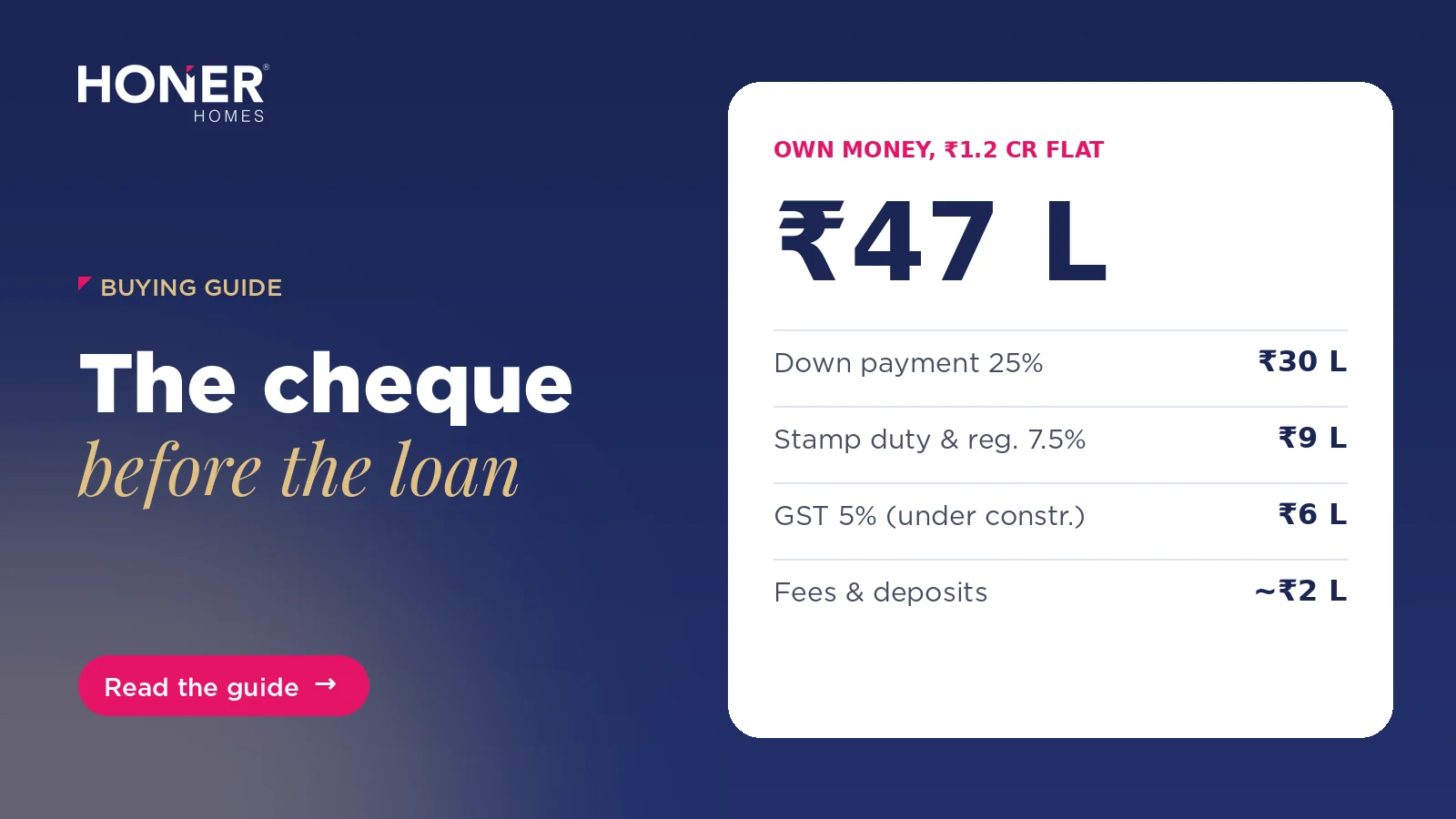
Worked example: a ₹1.2 crore flat
- Down payment (25%): Under construction: ₹30 lakh; Ready to move: ₹30 lakh
- Stamp duty and registration (7.5%): Under construction: ₹9 lakh; Ready to move: ₹9 lakh
- GST (5%): Under construction: ₹6 lakh; Ready to move: Nil
- Maintenance deposit, legal and loan fees (approx.): Under construction: ₹2 lakh; Ready to move: ₹2 lakh
- Your own money: Under construction: about ₹47 lakh; Ready to move: about ₹41 lakh
Illustrative. GST of 5% applies to under-construction flats outside the affordable category. No GST is charged on a flat bought after the occupancy certificate is issued. Verify charges with your builder and the stamp duty guide.
The bank lends the remaining ₹90 lakh, which at 7.5% for 20 years is an EMI of about ₹72,500. See our home loan EMI guide for other amounts.
Is a bigger down payment better?
Usually, yes, up to a point.
- Pros: a smaller loan, a lower EMI and less interest. Every ₹10 lakh less borrowed at 7.5% for 20 years saves about ₹9 lakh in interest.
- Cons: do not empty your savings. Keep 6 months of expenses plus your EMIs aside as an emergency fund, and money for interiors, which often cost ₹5 to ₹15 lakh.
How to save for a down payment
- Fix the number and the date. For example: ₹40 lakh in 4 years.
- Work out the monthly saving. ₹40 lakh in 4 years needs about ₹73,000 a month in a debt fund or recurring deposit earning around 6.5%.
- Keep it safe if the date is close. For money you need within 3 years, prefer fixed deposits, recurring deposits or short-term debt funds over equity.
- Use windfalls. Put bonuses, RSU sales and maturing policies straight into the house fund.
- Use payment plans wisely. Under-construction projects spread payments over the build period, so your contribution goes out in stages, not all on day one.
Can you use your PF for the down payment?
Yes. EPF rules allow a withdrawal for buying or building a home once you have enough years of membership, subject to limits. Check the current rules on the EPFO portal before you count on it.
Before you book
- Get a home loan sanction first, so you know exactly how much the bank will lend.
- Ask the builder for a full cost sheet: base price, floor rise, car parking, club, corpus fund, maintenance, GST and registration.
- Follow our buying checklist so nothing comes as a surprise.
Frequently asked questions
What is the minimum down payment for a home loan in India? It is 10% for loans up to ₹30 lakh, 20% for loans of ₹30 to ₹75 lakh, and 25% for loans above ₹75 lakh, under RBI rules. Banks may ask for more.
Does the home loan cover stamp duty and registration? Generally no. Stamp duty, registration and similar charges are paid from your own funds.
Is GST charged on ready-to-move flats? No GST is charged on a flat sold after the occupancy certificate is issued. Under-construction flats attract 5% GST outside the affordable segment.
Can I take a personal loan for the down payment? It is not advisable. Lenders check your total EMIs, and a personal loan raises your costs and can reduce the home loan you are eligible for.
